About 326 minutes
Walks and Words of Jesus: A Paragraph Harmony of the Four Evangelists — A Closer Reading
Theology
74,808 recorded words. 12 minutes difference from this book's estimate.
View Gutenberg source #35674
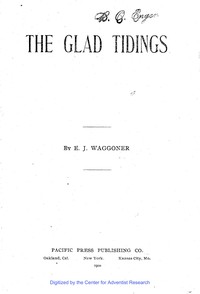
For The Glad Tidings — Edition Insights, the stored edition analysis reports 77,677 words, 5 hr 38 min estimated reading time, and 20 detected text sections.
The text analysis averages about 18.8 words per sentence, while the detected sections provide another way to judge how the source is divided.
Project Gutenberg metadata also associates the work with “Bible. Galatians -- Commentaries,” connecting these edition facts with the source record’s subject description.
Explore this collection
These alternatives are selected using recorded categories and estimated reading time.
About 326 minutes
Theology
74,808 recorded words. 12 minutes difference from this book's estimate.
View Gutenberg source #35674About 323 minutes
Theology
74,254 recorded words. 15 minutes difference from this book's estimate.
View Gutenberg source #32673About 361 minutes
Theology
82,970 recorded words. 23 minutes difference from this book's estimate.
View Gutenberg source #72761Search stored excerpts and compare books → Choose by your preferences →
Choices use stored catalog measurements. Estimates vary with reading speed. A shared category is a catalog label, not a claim that two books have the same argument or literary quality.
Search reads excerpt text stored with this catalog and links to its associated Gutenberg record. The connection is stored in the site database; this tool does not recheck that every excerpt is word-for-word identical to that external record. Excerpt search does not cover every chapter and does not verify historical publication dates.
Catalog snapshot checked: 2026-09-26. Coverage: 96 public books, 96 available source excerpts.
Calculated from edition completeness, EPUB availability, text structure and catalogue metadata. Not a user rating.
Total of 100 points, scaled to a 2.5-5.0 range. Editions with an empty description or a missing EPUB file are not scored.
Public-domain source text
The source text is kept in the dedicated reader, separate from this catalogue record and its commentary.
Waggoner opens with a methodological declaration: rather than supply a conventional introduction, he will let the Epistle to the Galatians speak for itself. He insists that nothing can substitute for the Scriptures themselves, and that any religious book should direct attention more sharply to the biblical text, not substitute human opinions for it. This sets a distinctive tone for the commentary—one that is both reverent toward the source material and wary of secondary authority.
The preface positions Galatians (along with Romans) as the source of the sixteenth-century Reformation, whose watchword, “The just shall live by faith,” Waggoner believes needs renewed emphasis. He expresses hope that the truth of this epistle will stir church and world as profoundly as in Luther’s day, hastening “the times of restoration of all things.”
Waggoner’s preface and opening chapter establish a deliberate method: he refuses to write a conventional introduction because such statements must be taken on authority before the reader has studied the book. Instead, he introduces the reader directly to the biblical text, arguing that one learns more by talking with a person than by hearing someone talk about him. This approach shapes the entire commentary, which proceeds verse by verse through Galatians.
The author is explicit about the purpose of his own writing: it should call people’s attention more sharply to the words of Scripture. Any work that substitutes a man’s opinions for the Bible, leading readers to rest content without further study, is “worse than useless.” This self-limiting claim gives the commentary a distinctive humility even as it makes strong theological arguments.
A central argument emerges in the middle excerpts: God’s precepts are promises. Waggoner contends that because God knows humans have no power, all that He requires is what He gives. When God says “Thou shalt not,” it is an assurance that if we trust Him, He will preserve us from the sin against which He warns. This transforms the law from a demand into a guarantee.
The author ties this to the giving of the law at Sinai. The “loud voice” with which the law was spoken, he writes, was the same voice that proclaims glad tidings from the mountain-tops (citing Isaiah 40:9). The terrifying circumstances—fire, darkness, earthquake—serve to reveal the greatness of God’s promise, because all the righteousness the law demands, God has sworn to give to those who trust Him.
Waggoner presents the law as an active agent in the hands of the Holy Spirit to induce acceptance of the promise. He quotes Jesus’ words about the Comforter reproving the world of sin, righteousness, and judgment, and argues that a person must feel need before accepting help. The law gives knowledge of sin, and that knowledge leads to confession and forgiveness.
The author uses a striking analogy: no one hates the person who saves his life by pointing out an unknown peril; such a one is regarded as a friend. So the law, by its warning voice, prompts flight from wrath and becomes loved. The psalmist’s words, “I hate vain thoughts, but Thy law do I love,” are cited as the natural response of one who has been warned and saved.
In the later excerpts, Waggoner distinguishes between the law in letter and the law in Christ. The law written on stone could not give life; its precepts are perfect but cannot transform themselves into action. He contrasts the “ministration of condemnation” with the “ministration of the Spirit,” through which believers receive the life of righteousness.
Righteousness, he insists, is not a dead theory or dogma but living action. Christ is both life and righteousness. The phrase “the Spirit is life because of righteousness” (Romans 8:10) is used to connect the Spirit’s work with the impartation of righteous living. The giving of the law, with all its terrifying accompaniments, served to emphasize the importance of the promise—not to overshadow it.
Waggoner’s commentary rewards readers who engage directly with the biblical text alongside his exposition. His method—refusing to substitute human opinion for Scripture—means that the commentary functions best as a companion that sharpens attention to Galatians itself. The recurring claim that God’s precepts are promises offers a distinctive lens for reading the epistle’s arguments about law, faith, and righteousness. Readers may find it useful to compare Waggoner’s interpretations with the biblical text and with other commentaries from the same period.
Years of shelving these volumes taught me that Waggoner’s Galatians—where the law itself glows as a promise—shares a quiet pulse with Spiritual Victories Through the Light of Salvation — Themes and Context. Both whisper that light isn’t earned, but walked in. One finds freedom from bondage; the other, victory amid shadows. Together, they feel like old friends comparing the same sunrise over a long, patient afternoon.
Build a private reading journal entry for this title.