About 39 minutes
A Few Remarks on the Scripture History of Saul and the Witch of Endor — Reading Notes
Theology
8,819 recorded words. 3 minutes difference from this book's estimate.
View Gutenberg source #58017
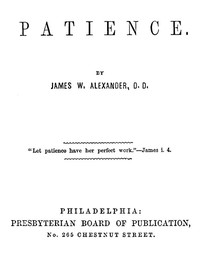
This digital edition of Patience — Story, Setting & Ideas is described by source-level measurements including 8,247 words, 36 min estimated reading time, and 1 detected text section.
The text analysis averages about 23.0 words per sentence, while the detected sections provide another way to judge how the source is divided.
Project Gutenberg metadata also associates the work with “Patience -- Religious aspects -- Christianity,” connecting these edition facts with the source record’s subject description.
Explore this collection
These alternatives are selected using recorded categories and estimated reading time.
About 39 minutes
Theology
8,819 recorded words. 3 minutes difference from this book's estimate.
View Gutenberg source #58017About 40 minutes
Theology
9,191 recorded words. 4 minutes difference from this book's estimate.
View Gutenberg source #58603About 31 minutes
Theology
6,938 recorded words. 5 minutes difference from this book's estimate.
View Gutenberg source #61086Search stored excerpts and compare books → Choose by your preferences →
Choices use stored catalog measurements. Estimates vary with reading speed. A shared category is a catalog label, not a claim that two books have the same argument or literary quality.
Search reads excerpt text stored with this catalog and links to its associated Gutenberg record. The connection is stored in the site database; this tool does not recheck that every excerpt is word-for-word identical to that external record. Excerpt search does not cover every chapter and does not verify historical publication dates.
Catalog snapshot checked: 2026-09-26. Coverage: 96 public books, 96 available source excerpts.
Calculated from edition completeness, EPUB availability, text structure and catalogue metadata. Not a user rating.
Total of 100 points, scaled to a 2.5-5.0 range. Editions with an empty description or a missing EPUB file are not scored.
Public-domain source text
The source text is kept in the dedicated reader, separate from this catalogue record and its commentary.
James W. Alexander's Patience (1852) is not a systematic treatise but a pastoral letter, originally delivered as a sermon and then written as a gift for a friend who had been bedridden for over two years with a painful, lingering malady. The work's occasion shapes its tone: intimate, urgent, and practical. Alexander anchors his meditation on James 1:4—'Let patience have her perfect work'—and immediately distinguishes Christian patience from mere endurance. The excerpts show a writer who is acutely aware that suffering can be wasted if it does not produce a full, transformative grace.
Alexander defines patience not as resignation but as 'a calm and unshaken state of mind, strongly bearing up against a present burden of distress.' He is careful to separate this from stoic indifference or the hardened silence of a 'western savage' or a malefactor facing execution. For Alexander, the Christian feels pain acutely—'the thrill of a poignant infliction runs through his quick and sentient nerve'—but is sustained by a joy that 'God pours in.' The key distinction is that religion 'makes his susceptibilities more tender' while opening 'new access for refined pleasures.' Patience, then, is not the absence of feeling but the redirection of it toward God.
A recurring concern in the excerpts is that believers might 'suffer and yet not profit.' Alexander warns against stopping short of 'the entire grace,' urging his reader to let patience have its 'perfect work.' This is not a call to passivity but to active cooperation with divine discipline. He observes that 'if the patience were perfect, the suffering would be annihilated, as to its effect on happiness.' The implication is that incomplete patience leaves the sufferer still vulnerable to despair. The text thus frames affliction as a process that must be seen through to its intended end, not merely endured.
Alexander argues that 'no great Christian character can be developed without some severe discipline.' He compares the Christian to a soldier who 'waxing hardier and more courageous after each success.' Yet he also addresses the common feeling of uselessness among the long-term ill: 'In the chamber of melancholy seclusion how many a soul has mourned that all opportunity of doing any thing for Christ was cut off.' His response is that when God's will is done, 'the great end of our creation, and our redemption, and our sanctification is accomplished, so far as we are concerned; whether it be by doing or by suffering.' This reframes the sickroom as a site of meaningful spiritual labor.
Alexander's Patience is best read as a document of its occasion: a pastoral gift to a specific sufferer, not a general manual. The excerpts reveal a writer who is theologically precise yet personally warm, drawing on Scripture and classical examples but always returning to the concrete experience of pain. Readers interested in nineteenth-century American devotional literature or the pastoral care of the sick will find here a focused, unsentimental treatment of a virtue often misunderstood.
Reading Patience again, I felt its quiet insistence that waiting itself is a kind of active surrender. It reminded me, strangely, of the Weymouth New Testament in Modern Speech, Acts — Story, Setting & Ideas, where the disciples’ long pauses between journeys hold the same patient, breath-held quality. Both books make stillness feel less like emptiness and more like the ground beneath a step not yet taken.
Answer a few questions and save a private reflection on this device.