About 87 minutes
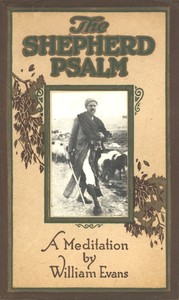
The Shepherd Psalm: A Meditation — Themes and Context
Comparative Religion
19,890 recorded words. 5 minutes difference from this book's estimate.
View Gutenberg source #33349
Before opening The Threshold Grace: Meditations in the Psalms — A Reader’s Guide, the edition data offers a quick orientation: 18,645 words, 1 hr 22 min estimated reading time, and 2 detected text sections.
The text analysis averages about 18.6 words per sentence, while the detected sections provide another way to judge how the source is divided.
Project Gutenberg metadata also associates the work with “Bible. Psalms -- Meditations,” connecting these edition facts with the source record’s subject description.
Explore this collection
These alternatives are selected using recorded categories and estimated reading time.
About 87 minutes
Comparative Religion
19,890 recorded words. 5 minutes difference from this book's estimate.
View Gutenberg source #33349About 110 minutes
Comparative Religion
25,271 recorded words. 28 minutes difference from this book's estimate.
View Gutenberg source #65115About 35 minutes
Comparative Religion
8,016 recorded words. 47 minutes difference from this book's estimate.
View Gutenberg source #12615Search stored excerpts and compare books → Choose by your preferences →
Choices use stored catalog measurements. Estimates vary with reading speed. A shared category is a catalog label, not a claim that two books have the same argument or literary quality.
Search reads excerpt text stored with this catalog and links to its associated Gutenberg record. The connection is stored in the site database; this tool does not recheck that every excerpt is word-for-word identical to that external record. Excerpt search does not cover every chapter and does not verify historical publication dates.
Catalog snapshot checked: 2026-09-26. Coverage: 96 public books, 96 available source excerpts.
Calculated from edition completeness, EPUB availability, text structure and catalogue metadata. Not a user rating.
Total of 100 points, scaled to a 2.5-5.0 range. Editions with an empty description or a missing EPUB file are not scored.
Public-domain source text
The source text is kept in the dedicated reader, separate from this catalogue record and its commentary.
Ainsworth opens with the phrase 'going out and coming in' from Psalm 121, treating it as a 'picture of life' that spans the literal threshold of home and the broader movement between private sanctuary and public duty. He notes that the 'division-lines in the life of man have nothing that corresponds to them in the love of God'—a structural principle that recurs throughout the meditations. Each chapter takes a single psalm verse as its anchor, then expands into a layered reflection that moves from the concrete to the spiritual, often returning to the image of a threshold or crossing.
The opening meditation establishes a pattern: a verse is quoted, its literal sense is honoured, and then it is opened into metaphor. 'Going out and coming in' becomes the rhythm of labour and rest, of facing 'vast industrial, commercial, and social problems' and returning to 'the sanctuary of love.' Ainsworth repeatedly uses spatial language—'crossing this threshold-line,' 'here or there,' 'the larger life of mankind'—to frame spiritual experience as a journey between realms. This movement is not merely physical; it is the soul's passage between the many and the few, the public and the private, the weary and the restored. The structure of the meditation itself mirrors this: it begins with the domestic threshold, moves outward to the world's work, and returns to the promise of divine keeping 'from this time forth and for evermore.'
In the later meditation on Psalm 91, Ainsworth turns to the experience of sorrow. He critiques a 'doxy that cannot interpret tears' and calls 'vanity upon the religion that is of no avail in the house of sorrow.' The silence that follows earthly song is not pitiable but 'divinely opportune,' because 'when the many voices grow dumb the One Voice speaks.' Here the structure shifts from movement to stillness: the threshold is not crossed but inhabited. Ainsworth insists that divine love does not merely condole but delivers, and that deliverance includes honour—'the honour of one whom the stress of life has driven into the arms of God.' He contrasts this with the human tendency to let cares 'rasp and fret and sting the manliness and the womanliness and the godlikeness out of us.' The meditation builds from the bare promise of deliverance to the 'nameless dignity of the crown of thorns,' a recurring image of suffering transformed into kingship.
Ainsworth addresses the problem of untimely death and the apparent unfairness of life's length. He writes that 'the measure of life is not written on a registrar's certificates of birth and death' and that 'who lives to God lives long, be his years many or few.' This section of the meditation moves from the promise of long life in Psalm 91 to a redefinition of longevity: faith and prayer 'discover and secure the eternal values of fleeting days.' The structure here is argumentative, almost homiletic, as Ainsworth challenges a literal reading of the psalm and offers a spiritual one. He does not dismiss the difficulty but reframes it, using the same threshold imagery—life and death as 'but an event' in a larger continuity. The closing phrase 'show him My salvation' becomes the summation of the entire meditation, gathering the earlier threads of deliverance, honour, and eternal life into a single promise.
Across the excerpts, certain images recur: the threshold, the going out and coming in, tears, silence, the crown of thorns, the 'bare promise' that is never bare. Ainsworth builds each meditation around a single verse, but the structure is not linear; it circles back to key phrases, deepening them with each return. The voice is pastoral and direct, often addressing the reader as 'my friend' or 'thy.' The movement between the literal and the metaphorical is consistent: a shepherd's flocks become the modern worker's market, the psalmist's tears become the reader's own sorrow. Ainsworth's method is to take the ancient text and press it into contemporary experience without losing its original weight. The result is a series of reflections that feel both anchored in scripture and responsive to the 'vast brooding weariness' of modern life.
These meditations reward a slow reading that attends to the movement between the literal and the spiritual. Ainsworth's structure—anchoring each reflection in a single verse, then expanding outward and returning—invites the reader to pause at the threshold of each promise. The recurring images of going out and coming in, of tears and silence, and of deliverance with honour form a coherent vocabulary of faith that is both ancient and immediate. Readers familiar with the Psalms will find fresh angles; those new to them will find a patient guide.
There are mornings when the Psalms feel less like words and more like a doorway, and Ainsworth catches that hush between coming and going. It made me think of another voice, quieter still, tracing the deer’s longing for water-brooks. The Hart and the Water-Brooks: a practical exposition of the forty-second Psalm. — Inside the Classic lingers the way a held breath does, patient and kind.
Create a short personal record of your experience with this book.