About 165 minutes
The Shepherd Of My Soul — Themes and Context
Comparative Religion
37,865 recorded words. 4 minutes difference from this book's estimate.
View Gutenberg source #30579
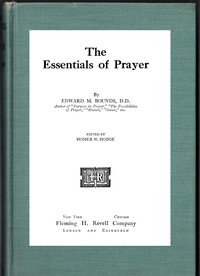
Essentials of prayer — Key Ideas to Explore can be approached with a clearer sense of reading commitment from its source measurements: 36,805 words, 2 hr 41 min estimated reading time, and 20 detected text sections.
The text analysis averages about 18.6 words per sentence, while the detected sections provide another way to judge how the source is divided.
Project Gutenberg metadata also associates the work with “Prayer -- Christianity,” connecting these edition facts with the source record’s subject description.
Explore this collection
These alternatives are selected using recorded categories and estimated reading time.
About 165 minutes
Comparative Religion
37,865 recorded words. 4 minutes difference from this book's estimate.
View Gutenberg source #30579About 210 minutes
Comparative Religion
48,108 recorded words. 49 minutes difference from this book's estimate.
View Gutenberg source #42360About 110 minutes
Comparative Religion
25,271 recorded words. 51 minutes difference from this book's estimate.
View Gutenberg source #65115Search stored excerpts and compare books → Choose by your preferences →
Choices use stored catalog measurements. Estimates vary with reading speed. A shared category is a catalog label, not a claim that two books have the same argument or literary quality.
Search reads excerpt text stored with this catalog and links to its associated Gutenberg record. The connection is stored in the site database; this tool does not recheck that every excerpt is word-for-word identical to that external record. Excerpt search does not cover every chapter and does not verify historical publication dates.
Catalog snapshot checked: 2026-09-26. Coverage: 96 public books, 96 available source excerpts.
Calculated from edition completeness, EPUB availability, text structure and catalogue metadata. Not a user rating.
Total of 100 points, scaled to a 2.5-5.0 range. Editions with an empty description or a missing EPUB file are not scored.
Public-domain source text
The source text is kept in the dedicated reader, separate from this catalogue record and its commentary.
Edward M. Bounds opens Essentials of Prayer by insisting that prayer engages the entire person—not merely the intellect or emotions but the will, the body, and the spirit. The book’s structure moves through a series of linked conditions: humility, devotion, praise, trouble, God’s work, and consecration. Each chapter builds on the previous one, creating a cumulative argument that prayer is both a discipline and a relationship. Bounds frequently contrasts superficial religiosity with genuine, costly devotion, warning against self-deception and empty forms.
The first chapter sets the tone by asserting that prayer is not a partial or occasional activity but one that demands the full engagement of the believer. Bounds writes that prayer “takes in the whole man,” implying that mental distraction, emotional coldness, or physical lethargy undermines its effectiveness. He repeatedly uses the phrase “whole man” to emphasize totality, a motif that recurs throughout the text. The language is direct and exhortatory, often shifting into short, imperative sentences that mimic the urgency of the subject. Bounds does not offer a systematic theology of prayer; instead, he presents a series of moral and spiritual demands, each tied to a specific aspect of Christian character.
In the second chapter, Bounds links prayer directly to humility, arguing that pride blocks genuine communion with God. He draws on biblical examples—the Pharisee and the publican, the centurion’s faith—to illustrate that prayer must begin with a lowly posture. The editor, Homer W. Hodge, notes in the foreword that Bounds’s own life exemplified this quality. The chapter’s structure alternates between doctrinal assertion and practical warning: “Prayer and humility are inseparable.” Bounds’s prose is repetitive for emphasis, a technique that reinforces his central claim that without humility, prayer becomes a hollow ritual. The recurring image of the “broken heart” appears here and later in the chapter on trouble.
The fourth chapter introduces a shift in tone: Bounds insists that prayer must include praise and thanksgiving, not merely petition. He argues that gratitude is a discipline that shapes the soul, and that neglect of praise leads to spiritual dryness. The chapter moves between exhortation and reflection, with Bounds quoting Scripture and occasionally citing hymn lines. The structure mirrors the book’s overall pattern: a thesis is stated, then expanded with biblical support, then applied to the reader’s life. Bounds’s voice is pastoral but firm, warning against “murmuring” and ingratitude. The chapter’s placement after “Prayer and Devotion” suggests a deliberate progression from inner disposition to outward expression.
The eighth chapter, “Prayer and Consecration,” draws together earlier themes by presenting consecration as the natural outcome of persistent prayer. Bounds defines consecration as “the voluntary set dedication of one’s self to God,” a phrase he repeats with slight variations. He contrasts true consecration with popular, superficial versions that lack prayer. The chapter includes an extended quotation from the seventeenth-century writer Gotthold, whose testament bequeaths his soul and family to Christ—a striking image of total trust. Bounds’s argument here is cumulative: prayer leads to humility, devotion, praise, and finally to a life wholly given over to God. The structure of the book itself mirrors this journey, moving from the individual’s inner life to outward service.
Bounds’s method is not analytical but hortatory: each chapter circles around a central virtue, reinforcing it through repetition, biblical citation, and pointed application. Readers will find the book most useful when taken slowly, one chapter at a time, allowing the cumulative weight of Bounds’s argument to press home. The editor’s foreword suggests that Bounds wrote for the “salvation of his readers,” and the text indeed functions as a spiritual exercise rather than a theological treatise.
There’s something about Essentials of Prayer that kept returning to me quietly, especially its gentle insistence on humility before God. It felt less like a lesson and more like a slow exhale. I found myself thinking of The Shepherd Psalm: A Meditation — Themes and Context afterwards, how both seemed to sit with the same quiet trust, as if prayer were simply resting in a presence already near.
Your answers remain private and are stored only in this browser.