About 82 minutes
The Threshold Grace: Meditations in the Psalms — A Reader’s Guide
Comparative Religion
18,645 recorded words. 5 minutes difference from this book's estimate.
View Gutenberg source #13267
The source record for The Shepherd Psalm: A Meditation — Themes and Context measures this digital text at 19,890 words, 1 hr 27 min estimated reading time, and 3 detected text sections.
The text analysis averages about 20.5 words per sentence, while the detected sections provide another way to judge how the source is divided.
Project Gutenberg metadata also associates the work with “Bible. Psalms, XXIII -- Meditations,” connecting these edition facts with the source record’s subject description.
Explore this collection
These alternatives are selected using recorded categories and estimated reading time.
About 82 minutes
Comparative Religion
18,645 recorded words. 5 minutes difference from this book's estimate.
View Gutenberg source #13267About 110 minutes
Comparative Religion
25,271 recorded words. 23 minutes difference from this book's estimate.
View Gutenberg source #65115About 35 minutes
Comparative Religion
8,016 recorded words. 52 minutes difference from this book's estimate.
View Gutenberg source #12615Search stored excerpts and compare books → Choose by your preferences →
Choices use stored catalog measurements. Estimates vary with reading speed. A shared category is a catalog label, not a claim that two books have the same argument or literary quality.
Search reads excerpt text stored with this catalog and links to its associated Gutenberg record. The connection is stored in the site database; this tool does not recheck that every excerpt is word-for-word identical to that external record. Excerpt search does not cover every chapter and does not verify historical publication dates.
Catalog snapshot checked: 2026-09-26. Coverage: 96 public books, 96 available source excerpts.
Calculated from edition completeness, EPUB availability, text structure and catalogue metadata. Not a user rating.
Total of 100 points, scaled to a 2.5-5.0 range. Editions with an empty description or a missing EPUB file are not scored.
Public-domain source text
The source text is kept in the dedicated reader, separate from this catalogue record and its commentary.
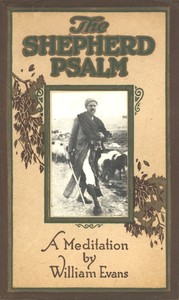
William Evans opens his meditation on Psalm 23 by declaring that the world could spare many libraries better than this six-verse psalm. The book's structure follows the psalm verse by verse, each chapter taking a single phrase as its title. Evans, a Bible teacher and author of numerous practical guides, writes from a homiletic tradition: the foreword explains that the text originated as sermons requested by listeners. The prose is direct and exhortative, frequently punctuated with hymns and poems that reinforce the chapter's theme. Evans draws on his own photograph of Palestine for the cover, grounding the pastoral imagery in a specific geography.
Evans repeatedly stresses the possessive pronoun in the opening phrase: my Shepherd. In the introduction he imagines the psalm's verses having tongues to recount their ministry across centuries, from sickbeds to scaffolds. The author's method is to unpack each word of the verse, so that I shall not want becomes a claim of divine sufficiency rather than mere absence of lack. He cites the Scottish preacher George H. Morrison and others, but his own voice is most evident in the repeated pattern of stating a truth, then amplifying it with rhetorical questions and exclamations. The phrase He leadeth me receives a full poem by Joseph H. Gilmore, and Evans adds his own commentary on the distinction between God's will for character and for career.
In the chapter on paths of righteousness, Evans introduces a distinction between God's general will for character and His particular will for career. The general will, he writes, is plainly declared in scripture—sanctification. The particular will requires quiet discernment between the soul and God alone. He illustrates with a minister who received two pastoral calls, one offering a stipend of $3000. The excerpt breaks off, but the pattern is clear: Evans uses concrete, homely examples from ministerial life. He insists that guidance comes through prayerful reading of the Word, where a scripture may decide a matter for one person though it does not bear the same meaning for another. This emphasis on personal application is a hallmark of his expository style.
Evans returns repeatedly to the verb leadeth, contrasting it with driving. He quotes John 10: He goeth before His own sheep and leadeth them, and argues that the Good Shepherd will not ask His followers to go where He has not gone. This pastoral image is extended into a meditation on the valley of the shadow of death, where the rod and staff become instruments of comfort rather than correction. The author's language is deliberately simple and repetitive, building a rhythm that mirrors the psalm's own cadence. He includes a poem by Dr. James M. Gray that plays on the phrase I shall not be missing, a slight but telling alteration of the familiar text. The effect is to make the psalm feel both ancient and immediately personal.
Evans's own photograph of Palestine appears on the cover, a detail that roots the meditation in a real landscape. Though the text does not describe the image, the fact that the author traveled to the region and chose that photograph suggests a desire to connect the biblical metaphor to observable geography. The foreword mentions that the book was produced at the request of hundreds who heard the sermons, indicating an oral origin. The prose retains traces of the pulpit: direct address, rhetorical questions, and a hortatory tone. Evans does not engage in critical exegesis; his aim is devotional application. The result is a work that treats the psalm not as a text to be analyzed but as a companion for the reader's own experience of guidance, comfort, and security.
Evans's meditation is best read as a series of extended sermon notes, each chapter circling a single phrase of the psalm. Readers interested in the history of devotional literature will find here a representative example of early twentieth-century homiletics, with its blend of scripture, poetry, and personal application. The book does not attempt to break new theological ground; its value lies in the transparency of its method and the earnestness of its tone. For those who wish to see how a seasoned Bible teacher unpacked the most familiar of psalms, this edition offers a clear window into that practice.
That rainy afternoon I kept returning to Evans’s calm assurance of green pastures, yet my eyes drifted to the margins, wondering about older sheepfolds. His quiet certainties made me curious about what people believed before. So I found myself turning pages of Ancient Faiths And Modern A Dissertation upon Worships, Legends and Divinities in Central and Western Asia, Europe, and Elsewhere, Before the Christian Era. Showing — Background and Themes, and the rain kept falling while one mystery led to another.
Your answers remain private and are stored only in this browser.