About 555 minutes
The wonders of prayer — Text and Context
Comparative Religion
127,513 recorded words. 178 minutes difference from this book's estimate.
View Gutenberg source #11553
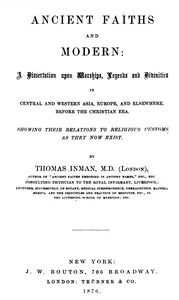
For Ancient Faiths And Modern A Dissertation upon Worships, Legends and Divinities in Central and Western Asia, Europe, and Elsewhere, Before the Christian Era. Showing — Background and Themes, the stored edition analysis reports 168,449 words, 12 hr 13 min estimated reading time, and 17 detected text sections.
The text analysis averages about 27.3 words per sentence, while the detected sections provide another way to judge how the source is divided.
Project Gutenberg metadata also associates the work with “Religions,” connecting these edition facts with the source record’s subject description.
Explore this collection
These alternatives are selected using recorded categories and estimated reading time.
About 555 minutes
Comparative Religion
127,513 recorded words. 178 minutes difference from this book's estimate.
View Gutenberg source #11553About 255 minutes
Comparative Religion
58,474 recorded words. 478 minutes difference from this book's estimate.
View Gutenberg source #29296About 210 minutes
Comparative Religion
48,108 recorded words. 523 minutes difference from this book's estimate.
View Gutenberg source #42360Search stored excerpts and compare books → Choose by your preferences →
Choices use stored catalog measurements. Estimates vary with reading speed. A shared category is a catalog label, not a claim that two books have the same argument or literary quality.
Search reads excerpt text stored with this catalog and links to its associated Gutenberg record. The connection is stored in the site database; this tool does not recheck that every excerpt is word-for-word identical to that external record. Excerpt search does not cover every chapter and does not verify historical publication dates.
Catalog snapshot checked: 2026-09-26. Coverage: 96 public books, 96 available source excerpts.
Calculated from edition completeness, EPUB availability, text structure and catalogue metadata. Not a user rating.
Total of 100 points, scaled to a 2.5-5.0 range. Editions with an empty description or a missing EPUB file are not scored.
Public-domain source text
The source text is kept in the dedicated reader, separate from this catalogue record and its commentary.
Thomas Inman, a consulting physician in Liverpool, opens his 1876 dissertation with an unexpected analogy: his medical experience taught him that doctors have limited power to cure, a skepticism he extends to religious institutions. The preface recounts how observing seven physicians' equal success rates led him to question authority—a stance that permeates his examination of ancient faiths. Inman does not merely catalog deities; he argues that Christianity borrowed from earlier traditions, particularly Buddhism and Persian religion, and that theologians systematically distort evidence. The work is structured as a series of comparative chapters, each targeting a specific tradition, with a polemical edge that challenges orthodox claims of uniqueness.
Inman's medical background shapes his methodology. He writes that after thirty years of study, he concluded that recovery is 'little influenced by the medicine given,' and that doctors 'magnify their office to the utmost.' This distrust of professional authority extends to theologians, whom he accuses of 'systematically break the ninth commandment' by bearing false witness against other faiths. The preface frames the entire work as an investigation into truth, unafraid of 'imaginary dangers.' Inman's tone is combative: he compares theologians to merchants using false weights, a metaphor drawn from Washington Irving. This opening establishes a pattern of using secular expertise to critique religious claims.
In the excerpts, Inman proposes a direct comparison between Buddhism and Christianity, claiming that if miraculous elements were removed from the Bible, little would remain except 'a certain amount of morality which is sound.' He suggests that the Bible could be improved by 'the teaching of Buddha or from the sayings of Socrates, Plato, Epictetus, and even of Confucius.' The text includes a 'parallel between Buddhism and Christianity' that Inman has drawn up, though the full table is not shown. This section reveals his method: he treats religious texts as human documents subject to emendation, and he insists that morality is universal, not divinely revealed to a single tradition.
Chapter VII examines the Medo-Persians and Parsees, focusing on Zoroastrianism's influence on Biblical theology. Inman questions the authenticity of the Avesta, calling it 'condemned,' and relies on Herodotus for an account of ancient Persian faith. He identifies a key innovation: the 'period of introduction of the Devil to the Bible.' This suggests that the concept of a dualistic evil force entered Jewish thought through Persian contact. Inman's approach is comparative and historical, not devotional. He accuses Christian divines of 'blazoning everything which is good, and veiling from sight everything which is doubtful' in other religions, a charge he applies across denominations.
Readers should approach Ancient Faiths And Modern as a polemical work of comparative mythology, not a neutral survey. Inman's medical lens and his explicit goal to 'disprove the assertion that God has selected a very small percentage of His creatures' give the book a consistent argumentative thrust. The excerpts show a writer who values universal morality over doctrinal purity and who is unafraid to accuse his opponents of deceit. For those interested in 19th-century freethought or the history of comparative religion, this text offers a vivid example of how Victorian skepticism used ancient sources to challenge Christian exclusivity.
That rainy afternoon, Inman’s brittle pages weighed heavy in my lap, his old arguments about borrowed gods settling like damp tea leaves. Yet somewhere between his insistence on universal ethics and the chill outside, I remembered a far gentler voice. By lamplight, I opened The Song of our Syrian Guest — Reading Companion, and the rain seemed to soften, its steady patter becoming something closer to companionship.
Save your reaction, strongest insight, and memorable passage.