About 87 minutes
The Shepherd Psalm: A Meditation — Themes and Context
Comparative Religion
19,890 recorded words. 23 minutes difference from this book's estimate.
View Gutenberg source #33349
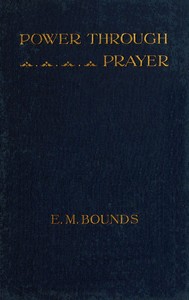
This digital edition of Power Through Prayer — A Closer Reading is described by source-level measurements including 25,271 words, 1 hr 50 min estimated reading time, and 21 detected text sections.
The text analysis averages about 19.5 words per sentence, while the detected sections provide another way to judge how the source is divided.
Project Gutenberg metadata also associates the work with “Prayer -- Christianity,” connecting these edition facts with the source record’s subject description.
Explore this collection
These alternatives are selected using recorded categories and estimated reading time.
About 87 minutes
Comparative Religion
19,890 recorded words. 23 minutes difference from this book's estimate.
View Gutenberg source #33349About 82 minutes
Comparative Religion
18,645 recorded words. 28 minutes difference from this book's estimate.
View Gutenberg source #13267About 161 minutes
Comparative Religion
36,805 recorded words. 51 minutes difference from this book's estimate.
View Gutenberg source #73271Search stored excerpts and compare books → Choose by your preferences →
Choices use stored catalog measurements. Estimates vary with reading speed. A shared category is a catalog label, not a claim that two books have the same argument or literary quality.
Search reads excerpt text stored with this catalog and links to its associated Gutenberg record. The connection is stored in the site database; this tool does not recheck that every excerpt is word-for-word identical to that external record. Excerpt search does not cover every chapter and does not verify historical publication dates.
Catalog snapshot checked: 2026-09-26. Coverage: 96 public books, 96 available source excerpts.
Calculated from edition completeness, EPUB availability, text structure and catalogue metadata. Not a user rating.
Total of 100 points, scaled to a 2.5-5.0 range. Editions with an empty description or a missing EPUB file are not scored.
Public-domain source text
The source text is kept in the dedicated reader, separate from this catalogue record and its commentary.
Bounds opens with a stark claim: 'Man is God's method.' The foreword by A. C. Dixon recounts how a friend's gift of the book led him to read it, finding that 'every page pulsates with the heart and mind of a man who knows how to pray.' The author's diagnosis is that the church seeks better methods, but God seeks better men. This sets the tone for a work that prioritizes the inner life of the preacher over external technique.
The two forewords, by Rev. A. C. Dixon and Mr. Albert A. Head, frame the book as a corrective to an age that neglects prayer. Dixon notes that he received the book twice as a gift before reading it, and that it made him 'feel more like praying.' Head identifies a need for 'power in prayer—desire for prayer—time to be devoted to prayer.' These endorsements signal that the book is not a systematic theology but a practical, devotional appeal. Readers should note that the forewords themselves contain key phrases—'Man is God's method'—that Bounds will develop throughout.
Bounds illustrates his argument with the example of David Brainerd, a missionary whose life was 'a life of prayer.' The excerpt describes Brainerd praying 'by day and by night,' before and after preaching, even while riding through forests. Jonathan Edwards is quoted praising Brainerd's 'wrestling with God in secret.' This section shows Bounds using biographical example to make prayer the central labor of ministry, not an adjunct to it. The repeated emphasis on 'heart' over 'head' prepares the reader for the later contrast between sermon preparation and heart preparation.
In chapter XII, Bounds directly critiques the overemphasis on sermon form. He writes that 'a prepared heart is much better than a prepared sermon' and that 'volumes have been written laying down the mechanics and taste of sermon-making, until we have become possessed with the idea that this scaffolding is the building.' The chapter quotes William Penn and Robert Murray McCheyne to reinforce that 'nothing reaches the heart but what is from the heart.' Bounds insists that prayer makes the preacher a 'heart preacher,' and that the preacher's mouth is opened and filled by prayer.
The book moves from general principle to specific application. Early chapters establish the primacy of prayer; later chapters apply this to preaching. Bounds uses a repetitive, aphoristic style—'Praying makes the preacher a heart preacher'—that reinforces his central thesis. The excerpts show a pattern: a scriptural or historical quotation, followed by Bounds's own commentary. Readers should watch for how he returns to the same themes (heart, method, power) with slight variations. The book's 21 chapters suggest a cumulative, meditative structure rather than a linear argument.
Bounds's book is best read as a series of meditations rather than a manual. The forewords and early chapters establish the urgency; the later chapters deepen the call to heart-centered ministry. Readers may find it helpful to read one chapter at a time, allowing the repeated emphasis on prayer to shape their own practice. The book's power lies not in novelty but in its relentless focus on the inner life of the preacher.
There are seasons when the pulpit feels lighter than the knees that carried us there. Bounds’s old warning about technique over prayer still catches me mid-stride. I find myself returning to the quieter arithmetic of dependence. Essentials of prayer — Key Ideas to Explore sits beside it now, like a familiar bench I never meant to find.
Build a private reading journal entry for this title.