About 25 minutes
The World English Bible (WEB): Song of Solomon — Text and Context
Theology
5,667 recorded words. 2 minutes difference from this book's estimate.
View Gutenberg source #8249
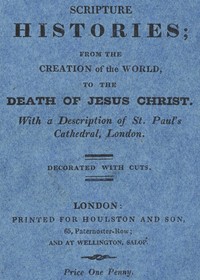
The source record for Scripture Histories; from the Creation of the World, to the Death of Jesus Christ With a Description of St. Paul's Church, London — Background and Themes measures this digital text at 5,097 words, 23 min estimated reading time, and 1 detected text section.
The text analysis averages about 22.5 words per sentence, while the detected sections provide another way to judge how the source is divided.
Project Gutenberg metadata also associates the work with “Bible stories, English -- Juvenile literature,” connecting these edition facts with the source record’s subject description.
Explore this collection
These alternatives are selected using recorded categories and estimated reading time.
About 25 minutes
Theology
5,667 recorded words. 2 minutes difference from this book's estimate.
View Gutenberg source #8249About 20 minutes
Theology
4,395 recorded words. 3 minutes difference from this book's estimate.
View Gutenberg source #37564About 27 minutes
Theology
6,014 recorded words. 4 minutes difference from this book's estimate.
View Gutenberg source #37670Search stored excerpts and compare books → Choose by your preferences →
Choices use stored catalog measurements. Estimates vary with reading speed. A shared category is a catalog label, not a claim that two books have the same argument or literary quality.
Search reads excerpt text stored with this catalog and links to its associated Gutenberg record. The connection is stored in the site database; this tool does not recheck that every excerpt is word-for-word identical to that external record. Excerpt search does not cover every chapter and does not verify historical publication dates.
Catalog snapshot checked: 2026-09-26. Coverage: 96 public books, 96 available source excerpts.
Calculated from edition completeness, EPUB availability, text structure and catalogue metadata. Not a user rating.
Total of 100 points, scaled to a 2.5-5.0 range. Editions with an empty description or a missing EPUB file are not scored.
Public-domain source text
The source text is kept in the dedicated reader, separate from this catalogue record and its commentary.
The frontispiece verse—'Great God! with wonder and on all thy works I look'—immediately establishes a tone of praise, but the prose that follows is brisk and factual. The Creation account compresses six days into a single sentence, listing 'the heavens, the earth, fire, air, water, birds, beasts, fish, and every creeping thing' before moving swiftly to Adam. This economy of language persists throughout the early excerpts: the Fall is narrated in a few paragraphs, with Eve's 'winning behaviour' and the 'gilded bait' of the fruit given equal weight. The serpent is not named Satan until the Eden story; later, the tempter is simply 'Satan' without elaboration. Readers should note how the anonymous author balances doctrinal summary with vivid, almost novelistic touches—Adam's 'extacy of joy' at Eve, the serpent's 'artful insinuations'—while maintaining a clear moral framework.
The early chapters of Scripture Histories move through Genesis at remarkable speed. The Creation is dispatched in one paragraph; the Fall, Cain and Abel, and Noah's Ark each receive similar treatment. The author selects only a few details per episode: Noah 'found grace in the eyes of the Lord,' the ark is 'of sufficient bulk,' and the flood is universal. There is no mention of covenant or rainbow. Instead, the moral is driven home by contrast—Seth's line 'called on the name of the Lord' while others indulged in 'riot and excess.' This pattern of swift narration followed by a pointed moral lesson recurs throughout. Readers will notice that the author rarely pauses for theological explanation; the stories are meant to be self-evident examples of obedience and disobedience. The language is plain, with short sentences and concrete nouns, making the text accessible to a young or newly literate audience.
As the narrative moves beyond the Pentateuch, the prose style subtly changes. The early patriarchs are described in a matter-of-fact tone, but later figures like Moses and Joshua receive more dramatic treatment. The crossing of the Red Sea is rendered with a sense of urgency: 'the waters stood up as a wall.' The author occasionally inserts direct speech, as when Moses cries out to the people. These moments of dialogue break the otherwise summary style and hint at the anonymous writer's skill in varying pace. However, the excerpts available do not include the full sequence from Exodus to the prophets, so it is unclear whether this shift is sustained. What is clear is that the author consistently avoids extrabiblical embellishment; the miracles are reported without skepticism or wonder, as straightforward facts. This restraint may reflect the work's intended use as a catechetical tool rather than a literary retelling.
The title promises a description of St. Paul's Church, London, and the final portion of the text delivers a concise architectural and historical account. The language here becomes more technical, noting dimensions, materials, and notable features such as the dome and the whispering gallery. The tone shifts from devotional to informative: 'the whole is built of Portland stone.' This section reads like a guidebook entry, complete with measurements and a brief history of the building's destruction in the Great Fire and subsequent reconstruction under Sir Christopher Wren. The juxtaposition of biblical narrative with a London landmark suggests the pamphlet was designed for both spiritual edification and local interest. Readers should consider how this dual purpose might have shaped the selection of biblical episodes—perhaps those with visual or moral parallels to the church's architecture and history.
Printed by F. Houlston and Son in Wellington and priced at one penny, this pamphlet belongs to the tradition of cheap religious tracts aimed at the poor and the young. The small word count—just over 5,000 words—and the inclusion of a frontispiece verse indicate a format meant to be read aloud or memorized. The author assumes no prior knowledge: Adam is 'called his name Adam,' and Eve is 'a more beautiful creature than himself.' The moral lessons are explicit and repeated, reinforcing the idea that the stories are examples of divine justice and mercy. The description of St. Paul's Church may have served a practical purpose, teaching children about a national monument while also linking the biblical past to their own city. The pamphlet's survival in digital form, produced from HathiTrust images, preserves a rare glimpse into 19th-century popular religious education.
This edition offers a window into a specific moment in publishing history, when biblical instruction and local pride could coexist in a single penny pamphlet. Readers approaching the text for the first time may find it useful to compare the narrative choices—what is included, what is omitted—with the fuller biblical accounts. The shift from Genesis to St. Paul's is abrupt but revealing; it suggests that the anonymous compiler saw no contradiction between sacred history and contemporary civic achievement. Whether used for study, curiosity, or historical research, the work rewards attention to its small-scale craft and its intended audience.
Holding that penny chapbook, I remembered my grandfather’s worn Bible, its margins filled with penciled dates and questions—how the stories felt like family news. Later, Our Day In the Light of Prophecy gave me that same hush of time made vast, though it spoke of what lay ahead. Both books felt less like instruction and more like a quiet hand on my shoulder. Our Day In the Light of Prophecy — Inside the Classic still sits on my shelf, a familiar weight.
Your answers remain private and are stored only in this browser.